Dysarthria can affect the way a person speaks, making communication feel frustrating, exhausting, or difficult to navigate in everyday life.
Because dysarthria impacts the muscles involved in speech, it can change how clearly words are produced, how the voice sounds, and how easily others are able to understand what is being said.
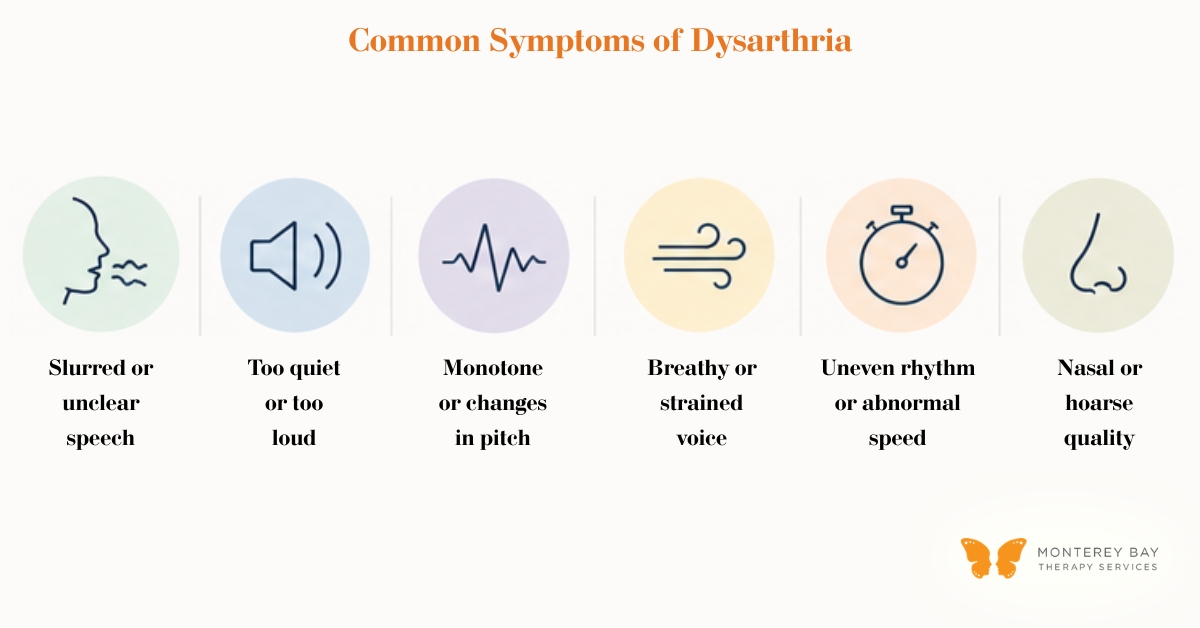
For some people, speech may sound slurred, quiet, breathy, monotone, or uneven in rhythm and pace.
These changes can happen gradually or suddenly, depending on the underlying cause.
Dysarthria can affect both children and adults, and it is often connected to neurological conditions or injuries that impact how the brain communicates with the muscles used for speech.
The good news is that speech therapy can help improve communication skills, increase speech clarity, and build confidence over time.
In this article, we’ll explore what dysarthria is, the different types and symptoms associated with it, what causes it, and how speech therapy can support clearer and more effective communication.
What Is Dysarthria?
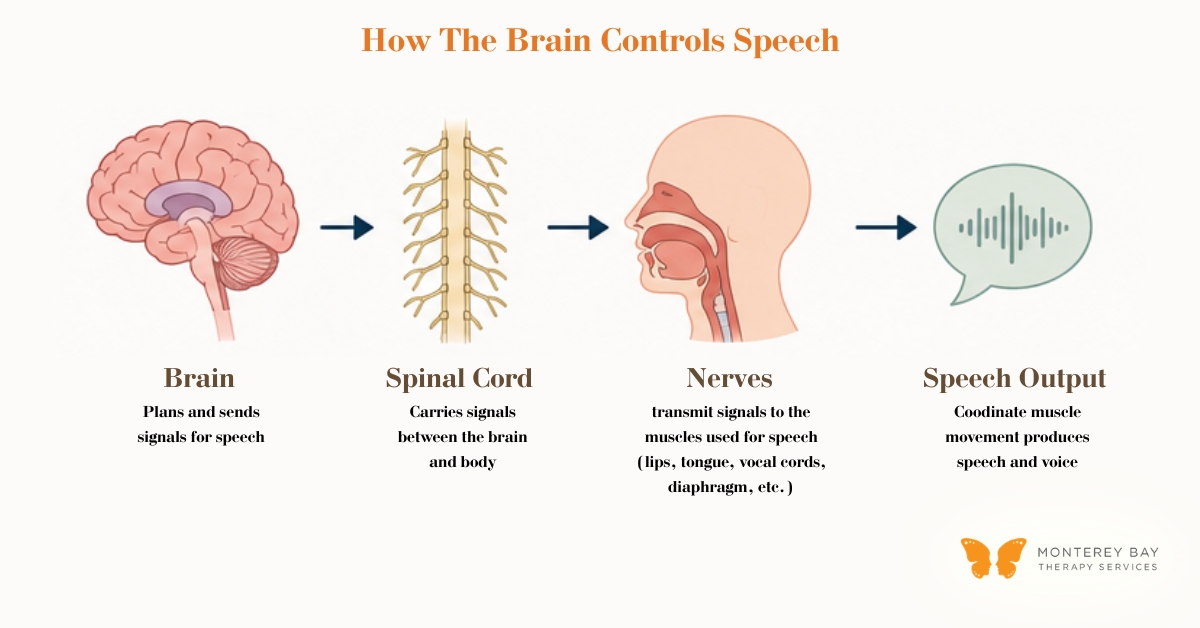
Dysarthria occurs when the muscles involved in speech are not controlled properly.
These muscles include the lips, tongue, vocal cords, diaphragm, and other structures involved in speech production.
These muscles are controlled by the brain and spinal cord, which together make up the central nervous system.
Sometimes, however, the connections between your central nervous system and the nerves that control your muscles directly can be damaged.
Lots of things can cause dysarthria.
Sometimes, the damage causing dysarthria can be inborn.
In this case, it’s called developmental dysarthria.
Other times, it can happen later in life.
If that’s the case, it’s called acquired dysarthria.
Whether it happens over time or has always been with you, dysarthria is often linked to another speech, language, or neurological condition.
For example, developmental dysarthria is often linked with cerebral palsy.
Acquired dysarthria may be linked to conditions such as stroke, brain tumors, or Parkinson’s disease.
Finally, if you’re an adult, your dysarthria is likely acquired.
What Are the Most Common Symptoms of Dysarthria?
We know dysarthria makes it difficult to be understood.
But how, exactly?
It can make it difficult to separate words when you speak.
This is sometimes called “slurred speech”.
It can also make it difficult to control your voice.
As a result, you may end up with speech that’s:
- Faster or slower than expected
- Louder or quieter than expected
- Higher or lower in pitch than expected
- Breathier than expected
- More nasal than expected
Sometimes, it can make speech production difficult altogether.
For example, you might find that your voice simply stops working.
It might also be the case that certain letters or sounds are harder to make at all times.
What Are the 7 Types of Dysarthria?
Your symptoms tend to align with the kind of dysarthria you have.
Usually, we separate dysarthria into six to seven types.
We’ll explore each type in more detail below.
Before we explore the different types of dysarthria, it’s helpful to understand the role of neurons.
Neurons are nerve cells that help control movement throughout the body, including the muscles used for speech.
They are found throughout the brain, spinal cord, and peripheral nervous system.
Together, the brain and spinal cord make up the central nervous system.
When you feel pain, at least one neuron is sending out a signal (firing).
Neurons also stretch into and out of your organs and other internal body structures.
All these neurons that aren’t in your brain or spinal cord are collectively called the peripheral nervous system (PNS).
Where do upper motor neurons come in?
They control movement.
This includes controlling the muscles you use to speak.
With dysarthria, there’s a disruption in that control.
That’s what causes the seven types of dysarthria, which we’ll examine in more detail below.
1. Flaccid Dysarthria
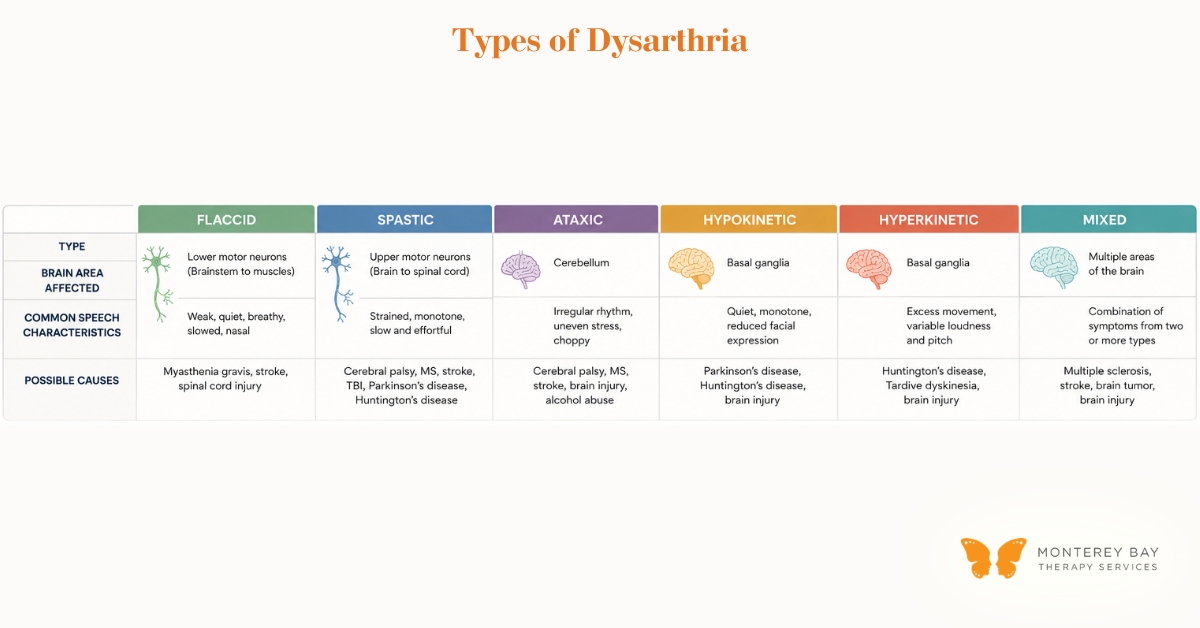
Flaccid dysarthria affects your lower motor neurons.
These are cells running from your brainstem to your voluntary muscles (those you can choose to move).
In flaccid dysarthria, the muscles become weak and lack normal muscle tone.
And when they’re not contracting, they’re not moving things.
In flaccid dysarthria, your speech may not move as quickly or as much.
This can result in speech that’s quieter, breathier, slower, or produced while breathing more through the nose (nasal).
Possible causes include:
- Myasthenia gravis (MG)
- Stroke
- Spinal cord injury
2. Spastic Dysarthria
Spastic dysarthria affects the upper motor neurons.
These are cells running from your brainstem into the top of your spinal cord.
It’s named for the muscle spasms it can cause.
At times, it can cause your speech muscles to freeze up.
Because of this, speech can sound as though it’s about to stop, or as though it’s happening despite an obstruction.
It can also sound relatively monotone.
Causes of spastic dysarthria may include:
- Cerebral palsy
- Huntington’s disease
- Parkinson’s disease
- Multiple sclerosis
- Stroke
- Traumatic brain injury
RELATED ARTICLE: Speech Therapy for Aphasia: Recovery Support After Stroke or Brain Injury
3. Ataxic Dysarthria
Ataxic dysarthria affects the cerebellum.
It’s on the back of the bottom of your brain, right next to your spinal cord.
It’s responsible for maintaining balance and coordinating muscle movements, among other functions.
In particular, your cerebellum helps you even out how long you spend saying certain things.
For example, it might decide how long you spend on one part of a word.
It helps you produce some sounds quickly, and others more slowly.
If your cerebellum isn’t helping with brain control of speech, though, you might not get quite as much choice in how long you say a given sound.
This can cause speech rhythm and timing to sound uneven or irregular.
Causes for ataxic dysarthria may include:
- Cerebral palsy
- Multiple sclerosis
- Stroke
- Traumatic brain injury
- Environmental exposure
- Genetics
4. Hypokinetic Dysarthria
Hypokinetic dysarthria affects your basal ganglia.
These are several larger parts deep in the lower half of your brain.
There are between six and nine individual structures, depending on how you divide them.
Different parts of your basal ganglia can cause different effects if their connections to other brain regions and to your muscles are broken.
For example, it’s the substantia nigra that’s usually most impacted if you’ve got Parkinson’s disease.
This usually comes with hypokinetic dysarthria.
In Huntington’s disease, by contrast, it’s the striatum.
Regardless of which basal ganglia region is involved, most cases of hypokinetic dysarthria share common features.
“Hypokinetic” means “low movement”.
In all cases of hypokinetic dysarthria, your speech muscles move less.
Reduced muscle movement can make speech quieter, less expressive, and more difficult to control.
Causes of hypokinetic dysarthria may include:
- Corticobasal degeneration
- Multiple system atrophy
- Parkinson’s disease
- Progressive supranuclear palsy
- Stroke
- Traumatic brain injury
5. Hyperkinetic Dysarthria
Hyperkinetic dysarthria also affects your basal ganglia.
It’s the opposite of hypokinetic dysarthria.
“Hypo-” means under.
“Hyper-” refers to increased or excessive movement.
So with hyperkinetic dysarthria, your speech muscles move more than average.
If these muscles are moving more, and suddenly, it makes sense that your speech might be faster, less uniformly timed, or less amenable to listener discernment of certain sounds than usual.
Possible causes of hyperkinetic dysarthria may include:
- Dystonia
- Huntington’s disease
- Multiple system atrophy
- Parkinson’s disease
- Tardive dyskinesia
- Tourette’s syndrome
- Certain medications
- Environmental exposure
6. Unilateral Upper Motor Neuron Dysarthria
Unilateral upper motor neuron dysarthria affects your upper motor neurons, as the name suggests.
These are cells running from the top of your brain through your brainstem to the start of your spine, where they meet the lower motor neurons.
Generally, it involves damage to only one side of your upper motor neurons.
It can result from several factors.
Regardless of the cause, damage on one side of the brain typically affects muscles on the opposite side of the body.
So if your right upper motor neurons are damaged, it will affect the muscles on the left side of your body, and vice versa.
In some cases, your brain may find ways to compensate for the damaged half of your motor neurons on its own.
However, this takes time.
7. Mixed Dysarthria
Most people with dysarthria have a mixed type.
This is a mix of symptoms from the six types we examined above.

How Speech Therapy Helps People with Dysarthria
Among the most frustrating parts of dysarthria may be that others don’t understand you as much or as quickly as before.
Thankfully, speech therapy for dysarthria can help.
If you’ve never worked with a speech-language pathologist before, here’s what the process may involve.
We’ll begin with an assessment of your or your child’s speech abilities.
This may involve exercises such as repeating words or phrases, counting aloud, reading, or smiling.
We may also assess breath control, as well as lips, tongue, and facial muscle control.
We’ll also take a detailed health history and ask a series of questions.
If you know of any diagnoses, please mention them as well.
The goal is to better understand what may be contributing to the symptoms.
In particular, your speech therapist will work to rule out other similar diagnoses.
For example, dysarthria and acquired apraxia of speech share similar symptoms but differ in treatment approaches.
This provides your speech therapist with the information needed to develop a personalized treatment protocol using therapy services tailored to your or your child’s needs.
You and your speech therapist will establish therapeutic goals together.
From there, speech therapy can begin.
Naturally, pediatric speech therapy for dysarthria differs from adult speech therapy, since children and adults often need different types of support.
With children, we focus on play-based interventions.
This may seem like we’re just playing games with your child.
But these are games designed with a therapeutic approach in mind.
On the other hand, adults typically don’t require a play-based approach.
But the goal is the same: to help build confident communication.
Book Your Appointment with Monterey Bay Therapy Services Today
Speech changes caused by dysarthria can feel frustrating and overwhelming, but the right support can make communication easier and more effective over time.
Whether dysarthria affects speech clarity, voice control, or the pace and rhythm of speech, individualized therapy can help strengthen communication skills and improve everyday interactions.
With consistent support and practice, many children and adults with dysarthria make meaningful progress in how they express themselves and connect with others.
Speech therapy not only focuses on clearer speech, but also on building confidence, independence, and quality of life in social, academic, and professional settings.
At Monterey Bay Therapy, we offer in-clinic care in Monterey Bay and online therapy services across California, making it easier to access support that fits your communication needs and lifestyle.
You can explore the areas we serve and how we deliver care across California to find the best option for you or your family.
Our team of therapists works closely with clients and caregivers to create practical, individualized plans that extend beyond each session and into everyday communication.
If you or your child are experiencing speech difficulties related to dysarthria, early support can make a meaningful difference.
Book an evaluation today and take the first step toward more confident and effective communication.